Thursday, June 30, 2016

APC. 5 Personal Ethics

APC. 5  Legal and ethical contexts in my digital practice


In my working world as a Resource Teacher Learning and Behaviour ( RTLB) these are just some of the ethical dilemma’s I have been faced with:
·      - Demands from parents to see in class observations that will prove the teacher is picking on their child
·      - Requests from schools for copies of in class observations to be used in competency hearings
·      - A teacher hitting a child

A range of ethical dilemmas were part of the work of the RTLB Association and these situations were part of the work done by the Ethics Committee on the National Executive of the Association. Our role was to guide and support the RTLB through an ethical decision making process. We were fortunate to access a workshop by Alan Hall in 2004 in Rotorua and the fundamental principles of ethical decision making have guided me through the years. I was also privileged to attend the early Ethics workshops developed by the NZ Teachers Council. Some of the take away gems for me were:

1.    An ethical decision is called for when an ethical dilemma is identified.
2.    An ethical dilemma will most often be a question of two competing rights or principles. A classic  example is the dilemma around a child’s right to attend school and a child’s right to be safe at school. A child hurting other children has a right to attend school but the other children have a right to be free from harm at school.
3.    Once you are aware of an ethical dilemma it is not possible to do nothing.
4.    Recording each of your steps to understand and work through the dilemma will provide a record of a considered decision making process. Diary and record any conversations that you have in consultation with others. This record provides legal confirmation of your considerations.
5.    People will disagree with your decision however your evidence of this being a considered decision protects you in the event of any legal action.
6.    Once something is said it cannot be unsaid. Once something is seen it cannot be unseen. Once something is heard it cannot be unheard.

In our digital world I would add that once something has been downloaded the trace of it is there forever. I once borrowed a teachers laptop when mine had crashed.  I went to google something and pornographic pictures came up of children. I closed the lid of the laptop in a panic and forced myself to go very slowly as this was an ethical dilemma with potential major consequences. I sought guidance from another professional person outside of our work situation. He outlined the legal issues and the possible steps that I could take. This was a personal laptop and not a work one. However the images of young children exposed a potential risk for the children in the teacher’s school. I had an obligation to first see to the safety of the most vulnerable – in this instance the children, while also protecting the career of a teacher who had kindly lent a laptop to a colleague. I decided to return the laptop in the presence of a non education third party.  The teacher immediately phoned a probation officer and asked me to stay while their boarder, the probation officer and his wife went through the laptop and the located the photo’s. The boarder confessed to downloading the photos and the probation officer went up and helped the boarder to pack his gear as he had broken his probation conditions and would be returning to prison. The teacher and his wife were part of a programme hosting prisoners on probation returning to society.

In hindsight, I was so very glad that I had stepped cautiously. I could have gone to the principal of the school and placed the teacher’s career in jeopardy.  In the last few years I have found the Tikanga Maori Model by Hirini Moko Mead (2003) to be very helpful in guiding me through some digital ethical dilemmas.  One instance is in placing a video of a special needs student having a dysregulated event of emotional distress. The film was taken without permission of the family and placed on a teachers professional portfolio website. The teacher was unaware that her portfolio was public. The parent googled her child’s name and located the film and was devastated at the invasion of privacy by a teacher. I was contacted by the parent.  The video was taken down and apologies made. The student has since left the school as the trust relationship between the school and the parent had broken down.

Analysing this incident through the Tikanga Māori Model in test one there was a breach of Tapu. There was no gain or positive outcome for the child in this breach. In test two the Mauri or essence of the child and the family was compromised.  The next test was to consider Take – utu – ea  that is the issue, the cost and the resolution that needs to be undertaken in order to restore relationships. Test 4 involves consideration of any precedents to help determine appropriate action. The final test five includes the consideration of Principles such as manaakitanga, whanaungatanga, mana and noa. 

These tests have links to the Beauchamp and Childress (2001)principles of autonomy, beneficence, nonmaleficence and justice. Principlism is founded on fundamental moral principles and DeMarco (2005) suggests a further principle of mutuality be considered. This principle places an obligation on people to consider the possibility of future ethical dilemma’s and act now towards removing the basis of potential conflict. In the case of digital practice this could mean training of teachers in privacy settings on social websites and the use of professional blogs.

The NZ Teachers Council is working within this mutuality principle with the establishment in early 2012 of the Social Media Project.  Ethical dilemmas have arisen for teachers and there was an evident need to develop guidance “so that teachers can embrace social media with confidence. “ (Education Council, 2016).

I recall words from a teacher in her 70th year when I was a  beginning teacher who told me to imagine there was a camera in my classroom and any part of my day could end up on National TV, change that to the internet and I believe that advice is just as relevant today.


DeMarco, J. P. (2005). Principlism and moral dilemmas : a new principle. 31. Retrieved June 22, 2016, from BMJ: http://jme.bmj.com/content/31/2/101.full.pdf+html
Education Council. (2016, June 18). Education Council and Social Media. Retrieved from Education Council Aotearoa: http://teachersandsocialmedia.co.nz/about-teachers-council-and-social-media-project
Mead, H. (2016, June 22). Tikanaga Maori Model. Retrieved from Rangahau: http://www.rangahau.co.nz/ethics/167/
Tom L. Beauchamp, J. F.Childress (2001). Principles of Biomedical Ethics Fifth Edition. London: Oxford University Press.


Wednesday, June 29, 2016

APC 4: Indigenous knowledge and cultural responsiveness in my practice

Indigenous knowledge and cultural responsiveness in my practice

Tahi kainga mate, rua kainga ora


Academic tasks such as this tend to fill me with a mild outrage these days. In earlier years it would be a more volcanic reaction.  The task pokes at my own sense of self. A painfully acquired sense of self.  I am Māori, I am Pakeha.  My whanau whakatauki calls on us to be at home as Māori and to be at home as Pakeha.

My grandfather is the source of my whakapapa. He left my mother when she was three years old and the closest I ever came to him was to be in the same room as he lay in his closed coffin. We never once laid eyes on one another. My great uncle gifted me copies of family papers he had accumulated over the years and these included the whanau whakapapa papers my grandfather had researched and recorded for the family. Potatau Te Wherowhero is my great great great great grandfather and I share the same whakapapa as Russell Bishop, our great great grandparents were siblings (Bishop, Collaborative Research Stories : Whakawhanaungatanga, 1996).  So why my outrage? Any teacher brings with them their own culture and their own heritage and values. As we enter the classroom, as we engage in any interpersonal encounter with another human being, our tupuna come with us, whispering in our ears, giggling, muttering, influencing all that we say and do. Some of our ancestors have louder voices than others at different times. Why should I be asked to reflect on who I am for an academic exercise? My tupuna clamour that this is my life’s work and not a shotgun moment of forced reflection.

As teachers we have a responsibility as part of our professional response to the students we teach to acknowledge and affirm who they are and it is our job to engage with our students in ways that touch and greet them in their world in authentic ways. Russell Bishop (Edtalks, 2012) speaks about agentic teachers, a term he borrows from Gloria Ladson-Billings and this reminds me of a phrase I came across many years ago ‘the teacher is the text’. Students learn from who we are and how we relate to them and how we respect who they are. Teaching is a reciprocal process always and this has been understood since the days Geoffrey Chaucer c. 1343 -1400. In the Prologue of his book The Canterbury Tales the clerk (commonly a teacher in those days) was delineated with the final words “…gladly would he learn and gladly teach.” (Chaucer, 1934, p. 10)

My teaching years at British International School in Bandar Seri Begawan, Brunei meant that I engaged in Deepavali celebrations with my students and visited homes during Chinese New Year and fasted in public during Ramadan. I sent cards to my Moslem parents and students for Hari Raya. There is valuable learning to step outside of one’s daily living into other spaces and places as they help you to see more clearly what you have in your own space and place. In Aotearoa in my working life there is a merging of who I am and whakawhanaungatanga is part of engaging with whanau all the time as I have living connections to many of the whanau that I work with. This is both an asset and a challenge.

In my role as a Resource Teacher of Learning and Behaviour (RTLB), our cluster Te Hā o Te Manawa espouses strong bicultural values in all our policy and administration documentation. Our challenge is to embed this into our practice with fidelity and consistency across the cluster. As the cluster stretches from Turangi to Murupara and includes Rotorua and Taupa we need to be mindful of Tikanga in Te Arawa, Tuhoe, Tuwharetoa, Tainui and Tuhourangi. RTLB receive focussed training in working with Māori students and our cluster employs people able to provide service to our Kaupapa Māori schools so in many ways we are demonstrating positive cultural responsiveness in our practice especially in our espoused Vision, Mission and core values. 
   
What may be missing is the checkpoints and monitoring of RTLB across the cluster in how we are embedding the culturally responsive elements of our vision and core values. We have an element of our appraisal system dedicated to reflecting on implementing Tataiako in our work but as this is a self reflection tool it has a weak element of accountability. There are three people in our leadership team and two of these are Māori while almost half of the RTLB are Māori RTLB practitioners.  I wonder if we need to have a buddy system of support for implementing cultural responsiveness in our casework? We have peer supervision groups twice a term and cultural responsiveness could be part of this work on a regular basis. These are the next steps we could take on our ongoing journey of increasing our cultural responsiveness.


Our cluster has been operational since 2012 and it is timely to review our organisation at the micro and macro level. Both Jill Bevan-Brown (Bevan-Brown, 2000) and Russell Bishop (Bishop & Glynn, Culture Counts : Change Power Relations in Education, 1999) have developed models to support organisational reviews of cultural responsiveness .

Fig 1 Cultural Audit Model by Jill Bevan - Brown

Our professional worlds must be culturally responsive to the students, families and schools as a matter of best practice for our students. Qualities of cultural responsiveness should not be a judgement on who we are, rather a judgement on how we acknowledge our students and their families.

Bevan-Brown, J. (2000). A Cultural Audit for Teachers. SET , 1. Retrieved June 18, 2016, from http://aromatawaiapaki.org.nz/content/download/235/1229/file/Acultural%20audit%20for%20teachers.pdf
Bishop, R. (1996). Collaborative Research Stories : Whakawhanaungatanga. Palmerston North: Dunmore Press Ltd.
Bishop, R., & Glynn, T. (1999). Culture Counts : Change Power Relations in Education. Palmeston North, NZ: Dunmore Press Ltd.
Chaucer, G. (1934). Canterbury Tales. New York: Garden City Publishing Company Inc.
Edtalks. (2012, September 23). A culturally responsive pedagogy of relations [video file]. Retrieved from htt[://vimeo.com/49992994


Tuesday, June 28, 2016

APC.3 Global Trends

APC 3. Global Context
My life has moved across the globe in the last two months from time in Beijing and walking on the Great Wall of China, Hong Kong and Macau to sending my heart across the world to Kuwait where a friend’s husband dies and she begins the arduous task of bringing him home to lie in Te Pakira Marae here in Rotorua. In my mind, I have been filtering my experiences of living in Brunei for eight years and the relationships I have formed with people of different cultures and religions across the world. It seems that the instantaneous knowing of events across the world such as knowing about the floods in my niece’s home town in New York state and that her boys are home from school on the same day that it is happening  changes the narratives of our lives. The instantaneous knowledge of world events in our homes via television and social networks makes the reality of the global village part of our daily lives. The common trends that touch us all across the world are broad and generalised and yet they touch our lives in the micro and macro levels. 

In the Future state 2030: the global megatrends shaping governments (2014)  there are ten fundamental trends identified across three domains, individual, physical environment and global economy. 

Fig 1.From Future State 2030: the global megatrends shaping governments 2014.

Some of these megatrends intersected with the themes of a documentary programme  I watched on the 25th May called World Class ? Inside NZ Education. The programme was hosted by Bryan Bruce who analysed and compared out education systems with other countries and asked  questions about what kind of systems did we need to have in order to have citizens able to participate and serve the country in the 21st century.
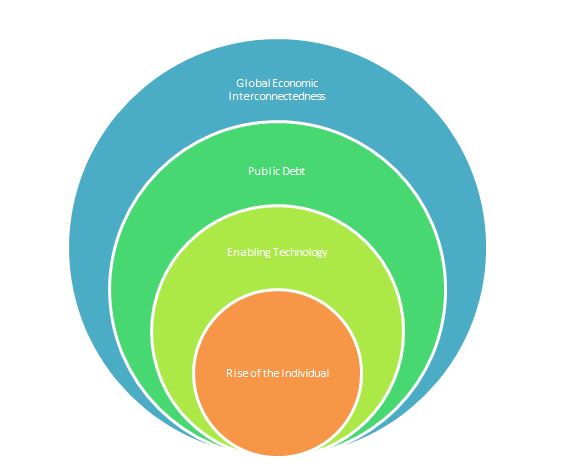
The four megatrends below are ones that seem to be particularly significant in our current educational landscape.
1.    Global Economic Interconnectedness
2.    Public Debt
3.    Enabling Technologies
4.    Rise of the Individual
Fig 2 The Rise of the Individual is both a result of and a cause of the other three megatrends. 

Economic interconnectedness and public debt are a pair that drive international economies with education and a pragmatic need to bring about changes through well researched evidence based programmes. In New Zealand we are in the middle of a Review of Education Funding Systems for ECE (Early Childhood Education) and Schooling. Engagement with the consultation process closing on Friday 2nd  September 2016. New Zealand is not exempt from the need to scrutinise all education spending more than ever before and demanding accountability for expenditure. 

Two other distinct yet inter-related trends are the rise of the individual and enabling technology. The technology is enabling the rise of the individual. The digital technology that rips across culture, religion and borders means that individual consumers can combine at an international level and create world resistance to production on the basis of unethical production or non sustainable products. A person in a third world nation can have access to all the knowledge of the world when they become digital citizens. Individuals have choices about the type of schooling they wish their children to have and in New Zealand schools are far more accountable to governments and parents through National Standards. The testing that informs the overall teacher judgements has already seen a narrowing of the curriculum in New Zealand schools. The narrowing of the curriculum with reduced time spent in the arts, drama, music, social studies seems absurd at a time when we are competing in a global economy and with our small population our greatest advantages are invested in collaborative creativity and innovation while recent years have seen an increase in national testing and conformity. These were some of the inherent contradictions of our education system that were highlighted in the recent documentary World Class? Inside New Zealand Education. 

The world is both bigger and smaller. Digital technology makes distance almost meaningless and whatever happens in one part of the world will affect the entire world, we are all members of a global village. John Donne’s words have never been more appropriate “No man is an island, entire of itself; every man is a piece of the continent, a part of the main.” (1624)

Fig 3 Clipart Globe


Bruce, B. (Director). (2016). World Class? Inside New Zealand Education [Motion Picture]. New Zealand.
Donne, J. (2016, June 12). Meditation 17, Devotions Upon Emergent Occasions. London, England. Retrieved from https://en.wikipedia.org/wiki/No_Man_Is_an_Island
The Mowat Centre. (2014). Future state 2030: the global megatrends shaping governments”. KPMG International Cooperative: USA. Retrieved. Toronto. Retrieved June 8, 2016, from http://www.kpmg.com/Global/en/IssuesAndInsights/ArticlesPublications/future-state-government/Documents/future-state-2030-v3.pdf


APC.2 Cluster Culture

APC School Culture 


I work across many schools as an RTLB and will focus this reflection on my cluster. Te Ha o Te Manawa has more than 30 RTLB across a wide geographic area from Turangi to Rotorua and includes Taupo, Murupara, Repora, Whakamaru and Atiamuri. We are the heart of the North Island and include the iwi of Te Arawa, Tainui, Tuhoe and Tuwharetoai. Our cluster logo shows 4 corners, 4 eyes of the peoples who make up our place. The blues and greens represent the lakes and the green lands that nurture us. 


Te Hā o Te Manawa Logo 

In the last 5 years since the RTLB service was transformed from many small clusters of 3-6 RTLB to our current figuration with a leadership of Cluster Manager and two Practice Leaders there have been many changes. As an organisation we have needed to maintain our service to schools while grappling with developing a new, shared organisational culture. During 2014 and 2015 the cluster has spent considerable time developing our cluster values.  Namely:
“Aroha underpins the following values:
  • Pono: Integrity/Honesty/Trust
Rationale: Honest, professional relationships and practice are integral to attaining excellence.
  • Tika : Respect
Rationale: We aspire to excellence by respecting and valuing the culture, environment and people with whom we interact.
  • Aroha: Empathy
Rationale: We see the need for inclusion, diversity and understanding by viewing the world through the eyes of others. “

There has been full agreement on the articulated values. The representation of these is still being developed and the above example is in draft format.
It is the process by which they were developed that demonstrates best the aspirational culture of our cluster. Stoll and Fink (1996) identified 10 norms that were evident in effective schools (cited in Stoll, 1998) and several of these norms were present in our collaborative values process. We worked in small groups and discussed what was most important to us as individuals as RTLB. [We were working on this together].Each group then shared their thoughts and contributions. [There’s always someone there to help].We all looked for commonalities and shared understanding. [Everyone has something to offer].A small group of RTLB were delegated to work on further on the values of consensus.
One area of consensus was our desire for a bi-cultural expression of our values and members of the delegation group were tasked with engaging with the kaumatua of our area to ensure iwi voice was included in our cluster values. In hindsight, I believe that this consensus marked the growing of our cluster as whakawhanaungatanga, a metaphorical whanau (Bishop, Collaborative Research Stories : Whakawhanaungatanga, 1996).
What are the issues, challenges and changes facing our cluster? Change overload is a very real issue in the cluster.  Office changes, change of online referral and case management systems, changes in staffing, leadership and ongoing development of overarching systems that belong to Te Ha o Te Manawa are among our challenges. One such example is in the collaboratively developed appraisal system that has a working team of which I am a member. We have worked from a whole cluster small group process with some agreed elements and the establishment of a delegated group are now building that into an annual framework. Looking back it appears that this is a way of working in our cluster that is forming a pattern. This framework will meet our clusters need for legal requirements with appraisal and attestation while providing an authentic and robust system that supports diversity and professional growth within our cluster to better serve our schools. As within any organisation we work to constantly improve how we work.   Research confirms that school cultures “…shape and re-shape what people do, think, and feel. “ (Hongboontri & Natheeporn, 2014). This is what any culture does, It is the primary function of a family to transmit culture and I wonder if, in our transient, fast moving world where families are separated for work and economic reasons and living in different cities, different countries - if the people we share our daily lives with become more ‘family’ than our biological family.  I feel somewhat perturbed to think that the people I work with could be ‘more family’ than my own family. Certainly on a week to week basis, I spend more time in community with my work colleagues than I do with my own siblings. This begs the question if I am more ‘shaped ‘ by my work culture than I am by my family in what I do, think and feel and if there is a time when resistance to that shaping is a healthy step to take?


Bishop, R. (1996). Collaborative Research Stories : Whakawhanaungatanga. Palmerston North: Dunmore Press Ltd.
Bishop, R., & Glynn, T. (1999). Culture Counts : Change Power Relations in Education. Palmeston North, NZ: Dunmore Press Ltd.
Hongboontri, C., & Natheeporn, K. (2014, May). School Culture: Teacher's Beliefs, Behaviours and Instructional Practices. Australian Journal of Teacher Education, 39(5), 66-88. Retrieved from http://ro.ecu.edu.au/cgi/viewcontent.cgi?article=2332&context=ajte
Stoll, L. (1998, May 18). School Culture. Retrieved from Ministry of Education : Educational Leaders: http://www.educationalleaders.govt.nz/Culture/Understanding-school-cultures/School-Culture